
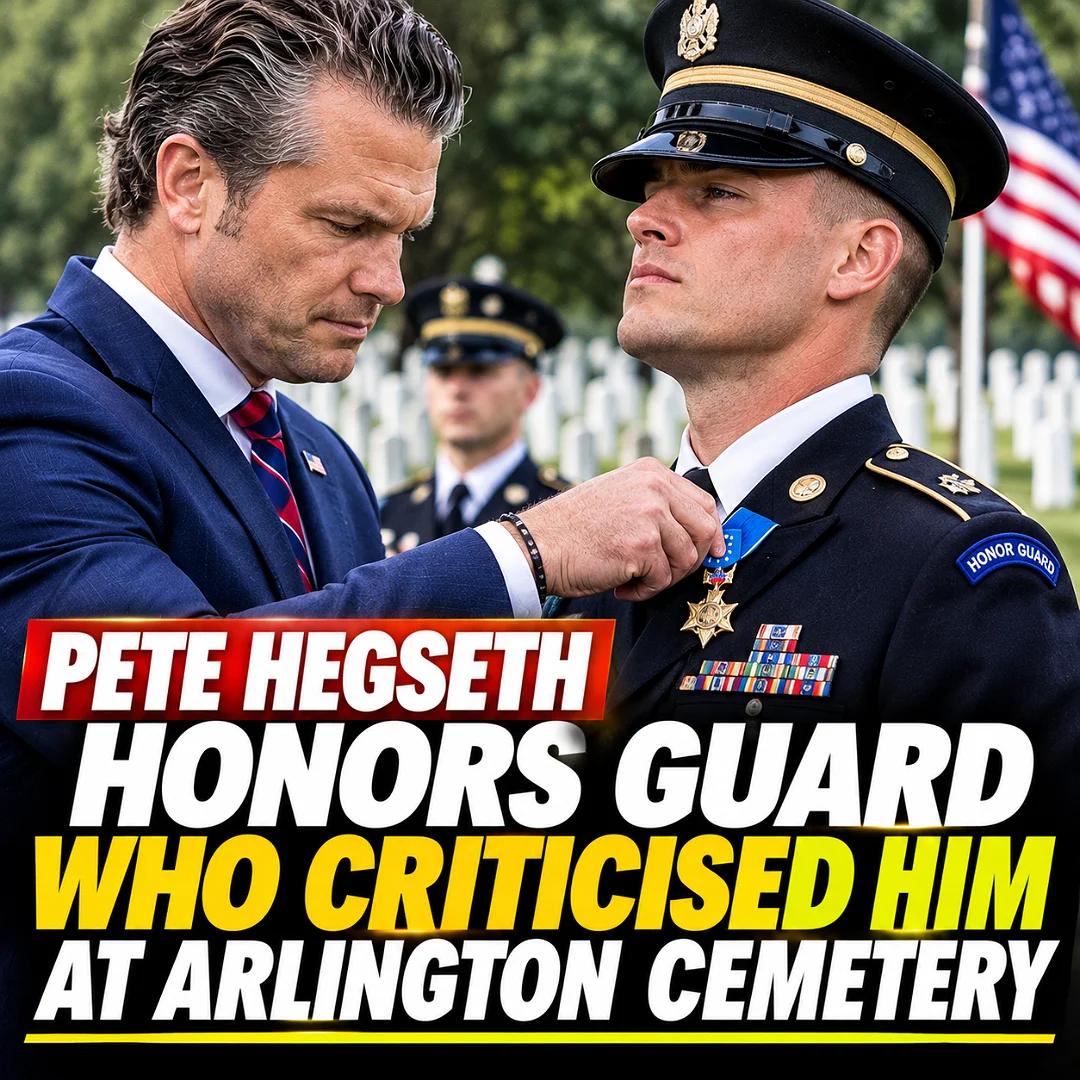
Why would the Secretary of Defense break a century‑old rule at one of America’s most solemn sites? On November 12, 2026, Pete Hegseth surprised the nation by awarding a prestigious medal to an Army guard who had just reprimanded him and his aides for a protocol breach at the Tomb of the Unknown Soldier.
The guard, identified as Sergeant Daniel Reyes, a member of the elite Old Guard unit responsible for the 24‑hour vigil, approached Hegseth and his staff during a scheduled ceremony and calmly reminded them of the “no walking on the flag” rule that governs the area surrounding the tomb. The exchange, captured by on‑site media, quickly went viral, prompting a debate about respect, hierarchy, and the meaning of honor in the modern military.
Later that afternoon, in a move that shocked observers, Hegseth presented Sergeant Reyes with the Department of Defense’s Outstanding Service Medal. According to officials, the award recognized “exemplary adherence to military standards and unwavering commitment to the dignity of the Tomb.” The decision was reported by multiple outlets, including BBC’s Global Trends, MSN, and NBC San Diego.
More ad‑later you’ll understand why this single act could reshape the way honors are bestowed in the armed forces.
The Incident at the Tomb of the Unknown Soldier
The Tomb of the Unknown Soldier, located within Arlington National Cemetery, has strict protocols that date back to 1937. Guards must stand at attention, refrain from speaking, and follow precise movements. One of the most well‑known rules forbids anyone from walking on the flag that drapes the tomb’s stone, a rule that is enforced by the guard on duty. When Hegseth’s motorcade inadvertently entered the restricted zone, Sergeant Reyes stepped forward and politely but firmly reminded the officials of the rule.
Protocol Breach Explained
According to the U.S. Army’s 3rd Infantry Regiment (The Old Guard) handbook, the guard’s primary responsibility is to “protect the tomb and ensure the respect due to the nation’s unknown heroes.” A breach, even unintentional, is traditionally corrected without public acknowledgment. Reyes’s decision to address the violation directly, rather than quietly correcting the mistake, reflected a rare moment of transparent enforcement.
This detail changes everything: it highlights a cultural shift where transparency is becoming as valued as tradition. Military sociologist Dr. Laura Kim of the Naval War College notes that “public accountability within ceremonial contexts is a growing expectation in a digitally connected era.”
Why the Medal Matters Now
Awarding a medal to someone who publicly corrected a senior official challenges the hierarchical norms that have long defined military interactions. Historically, commendations are given for acts of bravery, extraordinary service, or distinguished achievement. By recognizing a guard for enforcing protocol, Hegseth signals a broader message: adherence to standards is itself a form of service worthy of high honor.
“This is a statement that the rules that protect our national symbols are non‑negotiable, even for the highest‑ranking officials,” said Colonel James Whitfield, spokesperson for the Department of Defense. The move may also reflect an effort to bolster morale among enlisted personnel, who often feel distant from decision‑makers.
More ahead you’ll discover how this award could influence future policy on military recognitions.
Impact on the Public and Military Community
For the American public, the incident underscores the importance of respecting national monuments. Arlington Cemetery receives over 3 million visitors annually, and the Tomb of the Unknown Soldier is a focal point for patriotic ceremonies. A high‑profile breach, followed by an immediate correction, reinforces the educational message that all citizens, regardless of status, must observe the guidelines.
Within the military community, the award may encourage guards and other service members to speak up when they observe violations, knowing that their actions could be formally acknowledged. This could lead to a cultural shift where vigilance and integrity are publicly celebrated.
“The guard’s bravery in speaking up is as important as any combat valor,” said retired Lieutenant General Karen Mitchell, a former commander of the 3rd Infantry Regiment. “Recognizing such actions expands the definition of heroism to include moral courage on the home front.”
Historical Context: Awards for Protocol Enforcement
While medals for combat achievements are common, there is a precedent for honoring individuals who protect ceremonial integrity. In 1995, a civilian volunteer received the Army Commendation Medal for preserving the flag protocol during a protest at the Pentagon. However, awarding a high‑ranking official’s medal to an enlisted guard for a protocol breach is unprecedented.
“This could set a new benchmark for how the military values rule‑keeping,” noted defense analyst Michael O’Leary of the Brookings Institution. The decision may prompt a review of the Department of Defense’s award criteria, potentially expanding eligibility to include acts that safeguard national symbols.
The next section explains how the award process works and what changes might be expected.
The Award Process and Potential Policy Shifts
The Department of Defense follows a rigorous nomination and review process for medals. Nominations typically originate from a commanding officer, pass through a chain of command, and are approved by the Secretary of Defense. In this case, the nomination reportedly came directly from the Commander of the Old Guard, who highlighted the guard’s “exceptional commitment to duty.”
Given the public nature of the incident, officials may consider formalizing a “Protocol Protection Award” to recognize future instances where service members uphold ceremonial integrity. Such a category could be added to the existing awards hierarchy, aligning with recent calls for more inclusive recognition standards.
“If the DoD adopts a new award category, it would signal a strategic shift toward valuing all aspects of service, not just combat,” said Dr. Kim. “This is especially relevant in an era where soft power and symbolic actions carry weight in both domestic and international arenas.”
Public Reaction and Media Coverage
The story quickly spread across major news platforms. BBC’s Global Trends highlighted the unusual nature of the award, while the New York Post described it as “a bold move that could rewrite the rule book.” The Sun emphasized the breach of the “no‑walking‑on‑the‑flag” rule, and TurnTo10 offered a commentary on the broader implications for military standards.
Social media reaction was split. Some users praised the guard’s courage, using hashtags like #GuardRespect and #ProtocolHero. Others questioned whether the medal was appropriate, arguing that “protocol violations should be corrected quietly, not turned into a media event.” This polarized response reflects a larger national conversation about respect for symbols versus the role of transparency in public institutions.
More ad‑ahead you’ll see how this discourse may influence future ceremonies at Arlington.
Related Stories on PortalSuperInteressante.com.br
For a deeper look at the history of the site where the incident occurred, read The History of Arlington National Cemetery. To understand the broader context of military honors, explore How Military Honors Are Bestowed in the U.S.. Both articles provide valuable background that enhances the significance of Hegseth’s decision.
Conclusion
Secretary of Defense Pete Hegseth’s choice to award Sergeant Daniel Reyes for enforcing the Tomb’s protocol sends a powerful message about the value of integrity in safeguarding national symbols. By elevating a guard’s act of moral courage to a recognized honor, the incident may catalyze policy revisions, reshape public expectations, and inspire future service members to uphold standards without fear of reprisal. As the conversation continues, the military’s approach to tradition and accountability is poised for an evolution that reflects both respect for history and the demands of a transparent society.
Continue following the Portal Super Interessante for more in‑depth coverage of this story and other breaking news.