
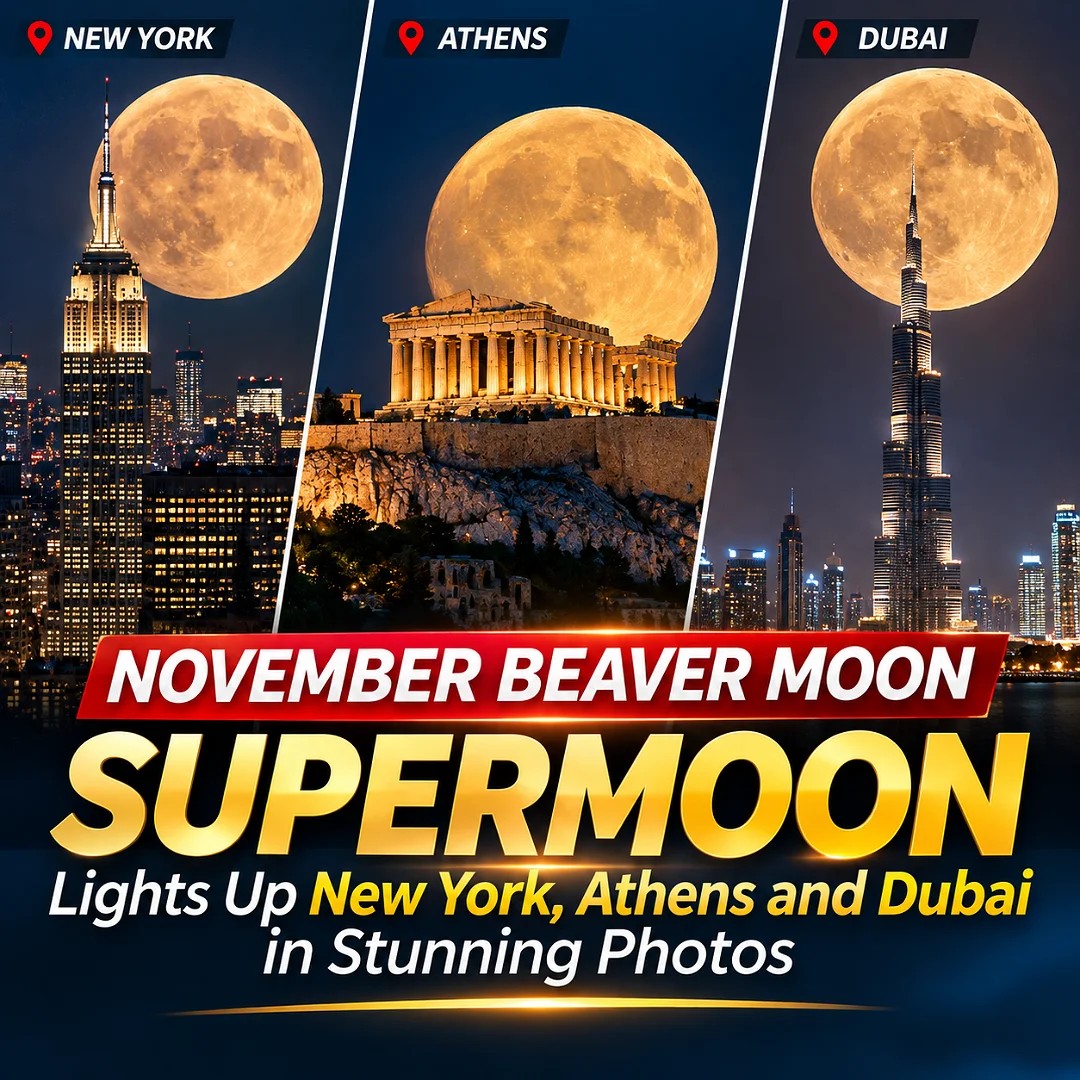
Did you look up on the night of November 24, 2026? If you did, you saw one of the year’s most talked-about sky events. The November Beaver Moon supermoon rose bright and full, and photographers around the world were ready for it.
From the skyline of New York to the ancient Parthenon in Athens and the glittering towers of Dubai, images of the glowing full moon spread fast across social media and news sites. Outlets including The Boston Globe, Space.com and the New York Daily News published galleries of the event.
But there is more to this moon than a pretty picture. It carries centuries of folklore, a handful of alternate names, and it opens a series of supermoons. Further down, you will see why that last detail matters for anyone who missed it.
What Happened on the Night of November 24, 2026
The full moon of November 2026 is widely known as the Beaver Supermoon. According to Space.com, the New York Daily News, News18 and IBTimes Singapore, the event took place on the night of November 24, 2026.
Across time zones, the timing looked a little different. News18 reported that in India, peak illumination arrived at 8:23 p.m. IST. That made it an easy evening target for viewers there, with no need to stay up late or wake before dawn.
Elsewhere, skywatchers simply stepped outside after sunset. As the moon cleared the horizon, it drew attention from casual observers and professional photographers alike. The result was a flood of images the next morning.
That flood is the reason the topic surged online. The Boston Globe’s coverage of the supermoon photos appeared among trending searches, reflecting how many people wanted to see what they had missed, or compare their own shots with the pros.
The November Beaver Moon Supermoon, Explained
To understand why this full moon got so much attention, it helps to break the name into two parts. “Supermoon” describes what the moon was doing in its orbit. “Beaver Moon” describes when it happened in the calendar.
What makes a full moon “super”
The moon does not travel around Earth in a perfect circle. Its path is an ellipse, so its distance from us changes throughout each orbit. The closest point is called perigee, and the farthest is called apogee.
A supermoon happens when a full moon lines up with the moon’s close approach to Earth. Because the moon is nearer than usual, it can look somewhat larger and brighter in the sky than an average full moon.
Here is the honest part, though. The difference is real, but it is subtle to the naked eye. Many people notice the extra brightness more than the extra size, especially in places with dark skies.
The term “supermoon” itself is not a formal astronomical category. It is a popular label that caught on with the public and the media. Astronomers often use the more technical phrase “perigean full moon” instead.
Why it is called the Beaver Moon
Traditional full moon names in North America come largely from a mix of Native American, colonial American and European folk traditions. These names were tied to seasonal events that mattered for daily survival.
The Beaver Moon is commonly linked to late autumn, when beavers are busy preparing for winter. They reinforce their lodges and store food before ponds and rivers freeze. In the past, this was also seen as a time to set traps before waters iced over.
That connection to nature is part of the appeal. Every November, the name reminds people that the season is turning and that colder months are close.
Frost Moon, Digging Moon and other names
The Beaver Supermoon goes by more than one title. According to a viewing guide published on Yahoo, it is also known as the Frost Moon or the Digging Moon.
The Frost Moon name points to the first hard frosts that often arrive in the Northern Hemisphere around this time. The Digging Moon name evokes animals burrowing and preparing shelters for winter.
Different cultures and regions have used different names for the same full moon. That variety is a quiet reminder that people everywhere have watched the same sky and given it their own meaning.
From New York to the Parthenon: Where the Photos Came From
Now comes the part most readers came for. Photos of the event, highlighted by MSN and the New York Daily News, captured the supermoon over some of the most recognizable places on the planet.
New York
New York is a favorite stage for moonrise photography. Skyscrapers give photographers a sense of scale, making a rising moon look dramatic against steel and glass.
The New York Daily News published images showing the November night sky lit up by the Beaver Moon supermoon. For city residents used to light pollution, a bright full moon is one of the few sky events that still cuts through the glow.
Athens and the Parthenon
Few scenes feel as timeless as a full moon over the Parthenon. Photos from Athens showed the supermoon near the ancient temple on the Acropolis, blending thousands of years of history with a sky event that happens on its own schedule.
Images like these go viral for a reason. They connect something modern people share instantly online with a landmark that has stood for millennia.
Dubai
Dubai offered a very different backdrop. Its futuristic skyline and desert setting gave the supermoon a contemporary, almost cinematic frame.
Together, these three cities tell a story. The same moon rose over a Western metropolis, an ancient European capital and a Middle Eastern hub, and people in each place stopped to look up.
Timing in India
India was another key part of the global conversation. News18 explained why the full moon was special and told readers how to watch it, with peak illumination at 8:23 p.m. IST.
That evening timing matters more than it seems. When a sky event peaks at a convenient hour, far more people step outside to see it. That is one reason coverage in India drew strong interest.
Why the Beaver Supermoon Matters Right Now
A full moon happens roughly once a month. So why did this one make headlines in so many countries?
First, timing. Late November is a season when many people are already outdoors in the evening, heading home earlier as daylight shrinks. A bright moon rising soon after sunset is hard to miss.
Second, it is shareable. Phone cameras have improved enough that ordinary users can capture decent moon shots. That turns a quiet natural event into a social one.
Third, and this detail changes everything, the November moon was described as the start of something bigger. News18 and IBTimes Singapore both reported that the Beaver Supermoon is the first in a series of supermoons. In other words, the show is not over.
How It Affects You
You do not need a telescope, a ticket or special training to enjoy a supermoon. That is what makes it one of the most democratic events in science.
For most people, the impact is simple. It is a reason to step outside, put the phone down for a few minutes and notice the sky. Many readers find that moment calming, especially during a busy season.
For parents and teachers, it is an easy science lesson. You can explain orbits, phases and distance using something kids can see with their own eyes.
For photographers, it is a practice opportunity. Learning how to shoot the moon now pays off later, when the next supermoon in the series arrives.
There is also a subtle physical effect worth knowing. When a full moon coincides with the moon’s close approach, tides can run slightly higher than usual. Coastal agencies sometimes note this, though the effect is typically modest on its own.
The First in a Series: What Comes Next
Here is where the story gets interesting for anyone who missed November 24. Because the Beaver Supermoon opens a series, more chances are on the way.
Coverage of the series also pointed toward Christmas Eve when discussing upcoming full moons. Exact dates, times and visibility for your location can vary, so it is smart to confirm with a trusted almanac or a reputable astronomy site before planning.
The total number of supermoons in this sequence was not specified in the reports reviewed for this article. The Hindu also published an explainer on what the Beaver Supermoon is and when the next supermoon is expected, which is a useful starting point for readers who want details.
The takeaway is simple. If clouds blocked your view in November, keep an eye on the calendar. You likely have another opportunity soon.
How to Photograph the Next Supermoon
Want your own shot to rival the viral images from New York, Athens and Dubai? These general tips can help, whether you use a phone or a dedicated camera.
- Shoot near moonrise. When the moon sits low on the horizon, you can frame it with buildings, trees or landmarks for scale.
- Lower your exposure. The moon is brighter than it looks. Tapping on the moon and reducing brightness on a phone helps keep surface details visible.
- Use support. A tripod or even a steady wall reduces blur, especially when zooming in.
- Plan your location. Many astronomy and photography apps show where the moon will rise, so you can line it up with a landmark.
- Try both wide and tight frames. A wide shot tells the story of the place. A close shot shows the moon’s craters and seas.
Patience matters more than gear. Many of the best moon photos come from people who arrived early and waited for the right moment.
The moon illusion
Have you ever noticed the moon looks huge near the horizon and smaller when it is high in the sky? That effect is known as the moon illusion.
The moon does not actually shrink as it climbs. The change happens in how our brains interpret size against nearby objects. This is why photos with landmarks, like the Parthenon shots, feel so dramatic.
Common Myths About Supermoons
Every big moon event brings a wave of claims online. Some are harmless fun. Others deserve a closer look.
“The supermoon looks twice as big”
Not quite. A supermoon can appear somewhat larger and brighter than an average full moon, but the change is gradual. Side-by-side photos taken months apart show it more clearly than the naked eye does.
“Supermoons cause disasters”
There is no reliable scientific basis for linking supermoons to catastrophic events. Mainstream scientific institutions have not identified supermoons as a cause of disasters.
“Full moons change human behavior”
This belief is old and widespread. Research on the topic has produced mixed and often inconclusive results, and no clear consensus supports dramatic behavior changes during a full moon.
The best approach is curiosity with a healthy dose of skepticism. Enjoy the view, and check claims against reputable science sources.
What We Still Don’t Know
Good reporting means being clear about the limits of the available information. Several details were not included in the reports reviewed for this article.
- The exact number of supermoons in the series has not been specified in the sources we reviewed.
- Precise peak times for every time zone were not detailed beyond the 8:23 p.m. IST figure reported for India.
- The names of the photographers behind every viral image were not available in the material reviewed.
As more details come out, readers should rely on established astronomy outlets and official almanacs for exact times in their region.
Sources Consulted
This article is based on reporting from the following outlets. Author bylines were not available in the material reviewed for this report, so sources are credited by publication and headline.
- The Boston Globe: coverage of Beaver Supermoon photos at peak.
- The Hindu: “What is Beaver Supermoon, when is the next supermoon and more.”
- Space.com: “November’s full moon rises tonight! Here’s how to see the Beaver Moon supermoon.”
- Yahoo: “November’s Supermoon: Your Guide to Viewing the Beaver Moon.”
- MSN: “November’s full moon dazzles skywatchers with a stunning Beaver Moon supermoon (photos).”
- New York Daily News: “November night sky lit up with Beaver Moon supermoon.”
- News18: “November 2026 Beaver Supermoon: Date, Time In India, Why This Full Moon Is Special And How To Watch It.”
- IBTimes Singapore: “November 2026 Beaver Supermoon Tonight: When, Where and How to Watch Biggest and Brightest Moon.”
Keep Exploring on Portal Super Interessante
If you enjoyed this story, browse more of our coverage: Moon and sky stories on Portal Super Interessante and Astronomy and science articles on Portal Super Interessante.
Suggested related topics for further reading:
- How lunar phases work and why the moon changes shape every night
- A beginner’s guide to stargazing from the city
- How tides respond to the moon and the sun
A Moon That Brings People Together
The November Beaver Moon supermoon was, in scientific terms, a predictable alignment of orbit and calendar. Yet the reaction to it showed something less predictable: how much people still want to look up together.
A photographer in New York, a visitor near the Parthenon in Athens, a resident gazing over Dubai and a family in India checking the time for peak illumination all shared the same moment. In a fragmented world, that kind of shared experience is rare and worth noticing.
And since this was only the first in a series, the next chance is not far away. Continue following Portal Super Interessante for the latest on sky events, science and the stories everyone is talking about.
Tags: Beaver Supermoon, November full moon, supermoon 2026, Beaver Moon, Frost Moon, Digging Moon, full moon photos, astronomy, stargazing, moon photography, New York, Athens, Dubai, India