
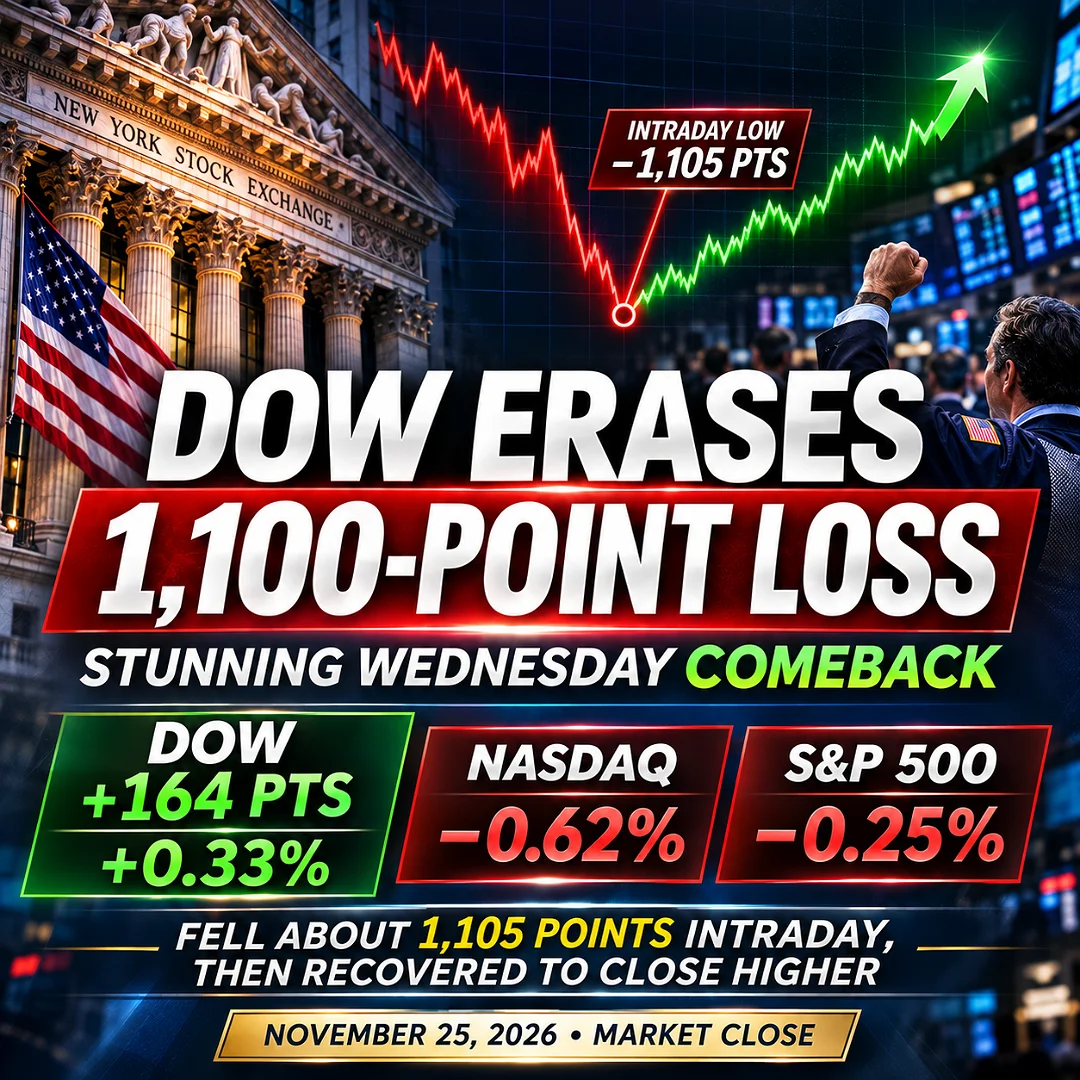
Can the stock market sink more than a thousand points in one session and still finish the day in positive territory? On Wednesday, the Dow Jones Industrial Average answered that question in dramatic fashion. It closed higher after wiping out a 1,100-point loss, a turnaround CNBC described in its live market coverage as a stunning rebound.
For anyone who checked their phone at the wrong moment, the day probably looked alarming. A four-digit drop on Wall Street tends to grab headlines fast. By the closing bell, though, the story had flipped completely.
So why does this matter now? The Dow is more than a number scrolling across a TV screen. It works as a mood ring for the American economy, and swings like this ripple into retirement accounts, business plans and everyday conversations about money. Later on, you’ll understand why the way the day ended matters more than the size of the drop.
What Happened to the Dow Jones Industrial Average on Wednesday
Here is what has been confirmed. The Dow Jones Industrial Average closed higher on Wednesday. Along the way, it erased a loss that had reached about 1,100 points. That information comes from CNBC’s live updates on the session, which became one of the most searched market topics of the day, according to Google Trends.
In plain terms, the index fell sharply at some point during trading. Then buyers came back with enough force to push it all the way back above where it started. That is the difference between a bad day and a comeback day.
A 1,100-point hole, filled in one session
Traders often talk about two very different numbers. The first is the intraday low, the deepest point the index reaches during the session. The second is the close, where the index settles when the trading day ends.
Most days, those two numbers stay relatively close together. On Wednesday, they told opposite stories. The intraday picture showed a steep slide. The closing picture showed a gain.
This detail changes everything. Headlines written in the middle of the day would have described a selloff. Headlines written after the close described a rebound. Same index, same day, completely different narrative.
What we still don’t know
Transparency matters, especially with market news. Based on the confirmed information available to us at the time of writing, several details have not been disclosed in our source material. These include the exact closing level of the index, the precise size of Wednesday’s final gain and the specific trigger behind both the drop and the recovery.
We are not going to guess. Markets react to many forces at once, and assigning a single cause without solid reporting would be misleading. Readers who want minute-by-minute detail can follow CNBC’s live coverage of the session, which is listed in the sources at the end of this article.
What we can do is explain why a move like this matters, how the Dow works and what it could mean for your wallet. That context is often more useful than any single number.
Why a 1,100-Point Swing Looks Bigger Than It Is (and Smaller Than It Feels)
A loss of 1,100 points sounds enormous. In some ways, it is. But the way the Dow is reported can make moves feel more dramatic than they would look in other measurements.
Points versus percentages
The Dow is usually quoted in points. Points tell you how far the index moved in absolute terms. Percentages tell you how big that move was relative to the index’s total level.
Here is why that distinction matters. When the index sits at a high level, a move of 1,000 points represents a smaller share of its value than it would have decades ago, when the Dow traded at much lower levels. A thousand-point drop today is not the same, proportionally, as a thousand-point drop in a much earlier era.
That does not make Wednesday’s swing trivial. It simply means the percentage figure is the better tool for comparing one day to another. Financial journalists and analysts often highlight percentages for exactly this reason.
Why the Dow moves in such big numbers
The Dow tracks a group of 30 large, well-established American companies, often called blue chips. Unlike many other indexes, it is price-weighted. That means companies with higher share prices have more influence on the index’s movement, regardless of the company’s total size.
Because of that structure, a big move in a few high-priced stocks can push the whole index sharply in one direction. It is one reason the Dow can post headline-grabbing point swings in a single session.
Now comes the curious part. The same mechanics that make the Dow fall fast can also make it recover fast. If those heavily weighted stocks bounce back, the index can climb out of a hole quickly. Wednesday appears to be a vivid example of that dynamic at work, though the specific stocks that drove the move have not been detailed in our confirmed information.
A Quick History Lesson: Charles Dow and an Index Born in 1896
To understand why one day of trading can dominate the news cycle, it helps to look back. According to Brazilian financial outlet Estadão, the Dow Jones Industrial Average is one of the oldest and most important stock indexes in the world.
The index was created in 1896 by Charles Dow, a cofounder of Dow Jones, the company that still carries his name. Think about that for a moment. The Dow has been around since before the first airplane flight and before most American homes had electricity.
Over more than a century, the index has lived through wars, recessions, booms, crashes and technological revolutions. Its very longevity is part of its power. Few financial yardsticks offer such a long continuous record of how American business has performed.
Why an old index still matters
Some critics argue that 30 companies cannot fully represent an economy as large and diverse as the United States. That debate is real, and many investors also watch broader benchmarks such as the S&P 500 and the Nasdaq Composite.
Even so, the Dow keeps its spot in the spotlight. As the investor education site from R7 points out, the Dow Jones index is one of the main benchmarks of the American stock exchanges. When news anchors say “the market” rose or fell, they are often talking about the Dow.
That cultural weight is exactly why a 1,100-point reversal becomes a national story. People who never buy individual stocks still recognize the name. And when the Dow lurches, it shapes how millions of people feel about the economy.
Why This Rebound Matters Right Now
A stock market that falls and then fully recovers in one day sends a mixed but meaningful signal. On one hand, the initial drop shows that something rattled investors enough to trigger heavy selling. On the other, the recovery shows that buyers saw the lower prices as an opportunity.
The psychology of a comeback
Markets are driven by numbers, but they are also driven by people. Fear can spread quickly during a selloff. Prices fall, more sellers join in, and the decline feeds on itself.
A rebound breaks that cycle. When buyers step in and the index climbs back, it can calm nerves and restore some confidence. Traders often pay close attention to days like this because they reveal how much demand is waiting on the sidelines.
Still, it would be a mistake to read too much into a single session. Mixed signals are exactly that: mixed. The reasons behind the initial drop do not simply vanish because prices recovered by the close.
One day is not a trend
This is where experienced investors tend to slow down. A stunning rebound makes for great headlines, but it does not guarantee what happens next. The following sessions often matter more for understanding whether the comeback had staying power.
Mais adiante, or rather, further down this article, you’ll see a short checklist of what to watch in the coming days. It can help you separate meaningful signals from daily noise.
How the Dow’s Wild Day Affects You
You might be wondering what any of this has to do with your life. The answer depends on how your money is invested, but for many Americans, the connection is closer than it seems.
If you have a retirement account
Millions of people hold stocks indirectly through workplace retirement plans such as 401(k)s, individual retirement accounts or index funds. Even if your fund does not track the Dow itself, the forces that move the Dow often move the broader market too.
On a day like Wednesday, anyone checking a retirement balance at midday might have seen a painful dip. By the close, much of that dip may have disappeared. This is a powerful reminder that intraday swings rarely tell the full story for long-term savers.
Financial educators frequently repeat the same advice for this reason. Checking your balance constantly during volatile sessions can increase stress without improving your decisions.
If you’re thinking about buying or selling
Days with dramatic reversals can tempt people into quick moves. Someone who panicked and sold near the low would have locked in a loss just before the market recovered. Someone who rushed to buy near the close is betting that the rebound continues.
Neither reaction is automatically right or wrong. But both show how emotion can drive costly timing mistakes. Many investors rely on a long-term plan precisely to avoid making big choices in the middle of a frantic session.
This article is informational and is not personalized financial advice. If you are considering major changes to your investments, a licensed financial professional can help you weigh your goals and risk tolerance.
Beyond your portfolio
The Dow also influences sentiment more broadly. Business owners, consumers and even policymakers watch the index as a rough gauge of confidence. Sharp swings can shape how people feel about spending, hiring and saving, even when the underlying economy has not changed overnight.
What to Watch Next After the Dow’s Rebound
Wednesday’s comeback raises a natural question: was this a turning point or a one-off? Nobody can answer that with certainty yet. However, a few signals can help you follow the story as it develops.
- The next few sessions: If the Dow holds or extends its gains, the rebound may reflect a real shift in sentiment. If it slides again, the recovery may have been short-lived.
- Broader indexes: Watching the S&P 500 and the Nasdaq alongside the Dow shows whether the move was widespread or concentrated in a few large stocks.
- Reported causes: As journalists and analysts dig into the session, clearer explanations for the drop and recovery may emerge. Reliable outlets will update their coverage as facts are confirmed.
- Percentage moves: Comparing daily moves in percentage terms gives a more accurate sense of how unusual the volatility really is.
Here is the key point. A single dramatic day becomes meaningful only when you see it in context. The coming sessions will help show whether Wednesday was a warning sign, a buying opportunity or simply a nervous market finding its footing.
Lessons From a Stunning Rebound
Every big market day leaves behind useful lessons, even for people who never trade a single share. Wednesday’s reversal offers several worth remembering.
- Headlines can change fast. A story about a steep drop can become a story about a gain within hours.
- Points can mislead. Large point moves sound dramatic, but percentages offer better perspective.
- Structure matters. Because the Dow is price-weighted, a handful of high-priced stocks can drive big swings in both directions.
- Patience often pays. Investors who reacted to the intraday low may have regretted it by the close.
- Context beats noise. One session rarely defines a trend.
There is also a historical lesson. An index founded by Charles Dow in 1896 has survived more than a century of turbulence. Days like Wednesday are part of that long story, not exceptions to it.
Final Thoughts on the Dow’s Wild Wednesday
The Dow Jones Industrial Average has spent more than 125 years translating the hopes and fears of investors into a single number. On Wednesday, that number swung from alarm to relief in one session. It erased a 1,100-point loss and closed higher, a reversal that reminds us how quickly sentiment can turn.
For everyday readers, the real takeaway is not the drama itself. It is the perspective. Markets will always have days that feel frightening in the moment. What matters most is understanding what those moves mean, avoiding panic and keeping long-term goals in sight. As more details about the session are reported, the full picture of this rebound will become clearer.
Continue following Portal Super Interessante for clear, reliable coverage of the stories moving markets, technology, science and everyday life. For more trending topics, visit the Portal Super Interessante homepage with the latest news and trends.
Related Topics You May Enjoy
- How the S&P 500 differs from the Dow Jones: why many investors prefer a broader benchmark.
- What a stock market correction really means: definitions, history and how long recoveries tend to take.
- Index funds explained for beginners: how everyday savers gain exposure to the market.
Sources
- CNBC, via Google Trends Global: Dow closes higher Wednesday, wiping out 1,100-point loss in stunning rebound: Live updates. Live coverage by the CNBC markets team.
- Estadão, E-Investidor: Dow Jones: o que é e qual a importância desse índice para investidores.
- R7, Investidor Sardinha: Dow Jones: o que é e qual é sua importância?
Individual author bylines for these sources were not available in the material we reviewed, so each is credited to its publication.
Tags: Dow Jones Industrial Average, Dow Jones, stock market today, Wall Street, stock market rebound, Charles Dow, market volatility, investing, retirement accounts, US economy